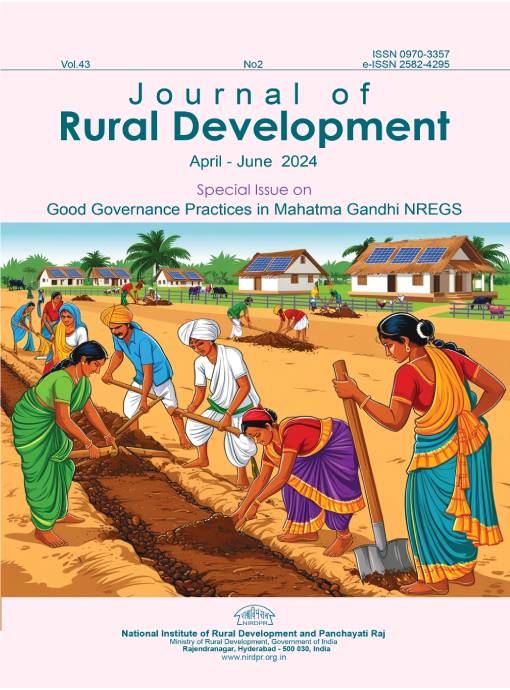
Implementation of Mahatma Gandhi NREGS: A State-wise Analysis of Efficiency, Effectiveness and Participation
DOI:
https://doi.org/10.25175/jrd/2024/v43/i2/173499Keywords:
Wage Employment, Efficiency, Effectiveness, Participation, Livelihoods.Abstract
The Government of India introduced the Mahatma Gandhi National Rural Employment Guarantee Act (Mahatma Gandhi NREGA) in September 2005. This law guarantees 100 days of paid work each year to adult members of rural households who need jobs and are willing to do unskilled manual labour. The programme aims to improve rural livelihoods and reduce poverty by providing wage employment. However, several issues have been found in how the programme is designed and managed, from the local Panchayat to the state and national levels. These challenges at the grassroots level have affected the programme’s success. It is important to understand what has worked well, what has not, and how the programme can be improved in terms of governance at the grassroots. Using data collected for a nationwide study from 7,950 households across 25 states, this paper reports challenges and issues that constrain implementation at the panchayat level. The findings show that some states are well ahead of others in terms of efficiency but lag behind in effectiveness. Based on these results, it can be concluded that the scheme’s governance still needs to be improved. The findings emphasise the importance of enhancing efficiency, fostering worker participation, and addressing entitlements to achieve sustainable livelihoods and meaningful outcomes across all states and UTs.
Downloads
References
Bhattacharjee, G. (2017). Mahatma Gandhi NREGA as Distribution of Dole. Economic & Political Weekly, 52, 25–26.
Bhattacharya, A., Kar, A., & Nandi, A. (2016). Local Institutional Structure and Clientelistic Access to Employment: The Case of Mahatma Gandhi NREGS in Three States of India. DOI: https://doi.org/10.2139/ssrn.2940724
Bhattacharyya, P. (2015). Empowerment of the Participants in Mahatma Gandhi NREGA. Man and Development, 37(1), 93–115.
Das, U. (2015a). Does Political Activism and Affiliation Affect Allocation of Benefits in the Rural Employment Guarantee Program: Evidence from West Bengal, India. World Development, 67, 202–217. https://doi.org/10.1016/j.worlddev.2014.10.009 DOI: https://doi.org/10.1016/j.worlddev.2014.10.009
Das, U. (2015b). Rationing and Accuracy of Targeting in India: The Case of the Rural Employment Guarantee Act. Oxford Development Studies, 43(3), 361–378. https://doi.org/10.1080/13600818.2015.1042445 DOI: https://doi.org/10.1080/13600818.2015.1042445
Das, U. (2019). Accuracy of Targeting under the Rural Employment Guarantee Programme: A Comparison between West Bengal and Rest of India. Journal of International Development, 31(2), 182–210. https://doi.org/10.1002/jid.3400 DOI: https://doi.org/10.1002/jid.3400
Dutta, M., Murgai, R., Ravallion, M., & Van De Walle, D. (2012). Does India’s Employment Guarantee Scheme Guarantee Employment? Policy Research Working Paper Series, No. 6003. The World Bank. https://doi.org/10.1596/1813-9450-6003 DOI: https://doi.org/10.1596/1813-9450-6003
Erlend Berg, Sambit Bhattacharyya, Rajasekhar Durgam, & Manjula Ramachandra. (2012). Can Rural Public Works Affect Agricultural Wages? CSAE Working Paper (Centre for the Study of African Economics).
Jha, R., Gaiha, R., & Pandey, M. K. (2013). Body Mass Index, Participation, Duration of Work and Earnings under the National Rural Employment Guarantee Scheme: Evidence from Rajasthan. Journal of Asian Economics, 26, 14–30. DOI: https://doi.org/10.1016/j.asieco.2013.03.001
Kumar, P., & Joshi, P. K. (2013). Household Consumption Pattern and Nutritional Security among Poor Rural Households: Impact of MGNREGA. Agricultural Economics Research Review, 26(1), 73–82.
Liu, Y., & Barrett, C. B. (2013). Heterogeneous Pro-poor Targeting in the National Rural Employment Guarantee Scheme. Economic and Political Weekly, 48(10), 46–53. DOI: https://doi.org/10.2139/ssrn.2198460
Ministry of Rural Development, Government of India. (2024). MGNREGS MIS data. Retrieved from https://nrega.nic.in Narayanan, S., & Das, U. (2014). Women Participation and Rationing in the Employment Guarantee Scheme. Economic and Political Weekly, 49(46), 46–53.
Narayanan, S., Das, U., Liu, Y., & Barrett, C. B. (2017). The “Discouraged Worker Effect” in Public Works Programs: Evidence from the Mahatma Gandhi NREGA in India. World Development, 100, 31–44. https://doi.org/10.1016/j.worlddev.2017.07.024 DOI: https://doi.org/10.1016/j.worlddev.2017.07.024
Pankaj, A. (2023). Inclusive Development through Guaranteed Employment: India’s MGNREGA Experiences. Singapore: Springer. DOI: https://doi.org/10.1007/978-981-15-7443-6
Srinivas, V., & Pandyaraj, A. (2016). MGNREGA and Women Empowerment: A Study of Pannur Village in Chittoor District of Andhra Pradesh in India. Journal of Agricultural Economics and Rural Development, 4(2), 436–453.
Srinivas, V., & Pandyaraj, A. (2017). Employment Generation and Asset Creation through MGNREGA in Andhra Pradesh. Journal of Global Economy, 12(4), 2455–2070. https://doi.org/10.1956/jge.v12i4.441 DOI: https://doi.org/10.1956/jge.v12i4.441
Sathyapalan, J., Rangacharyulu, S. V., Digambar A., Anuradha P., Neeraj Mishra, Jayasree, K., et al. (2020). Report on One Decade of MGNREGS. Centre for Wage Employment and Livelihoods, National Institute of Rural Development and Panchayati Raj.